
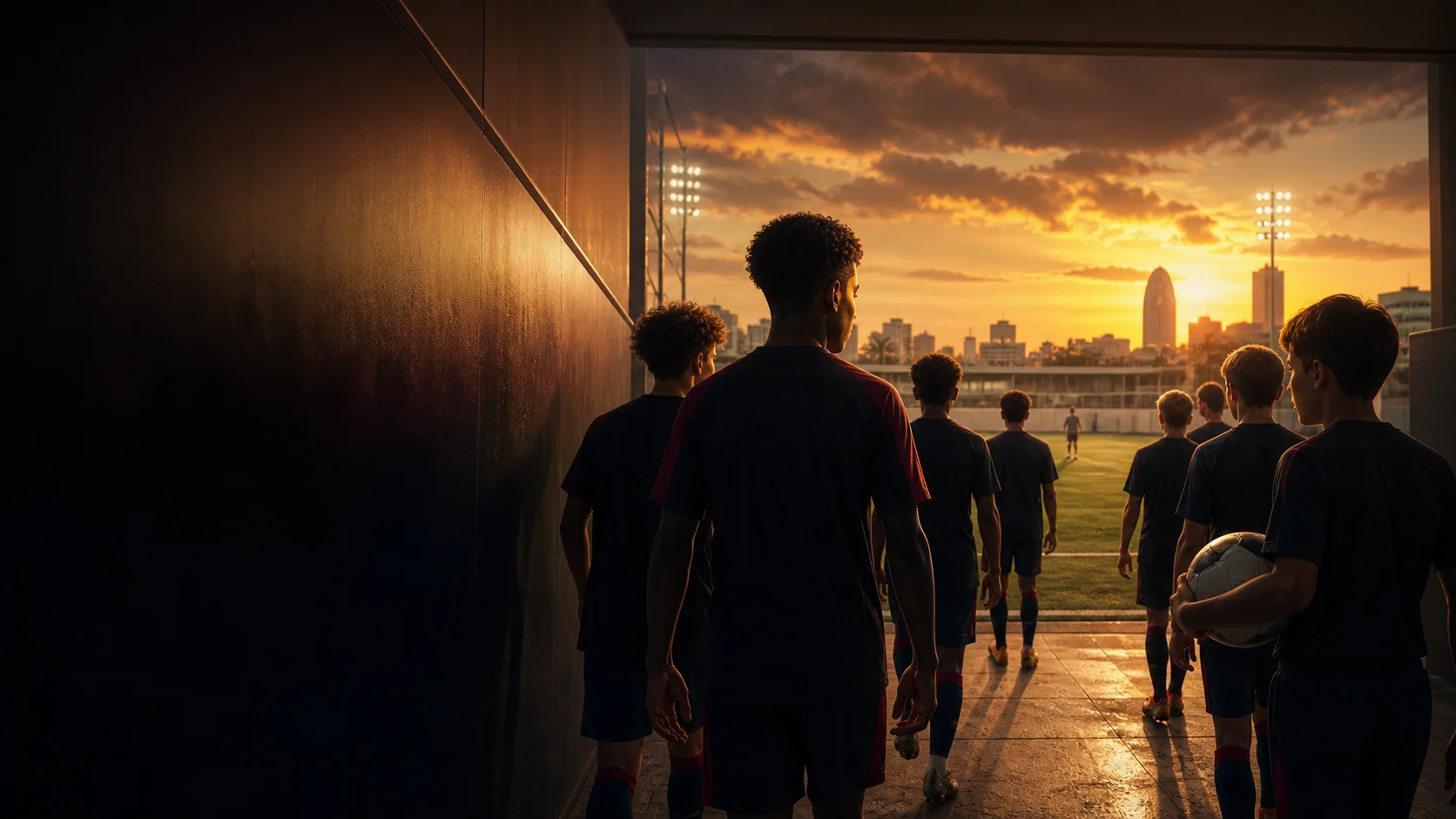
Spain are world champions again. Sixteen years after Andrés Iniesta’s goal in Johannesburg, Spain defeated Argentina in the 2026 World Cup final and placed a second star above the national crest.
Behind the trophy is a development story that matters far beyond one final. Eight members of Spain’s 2026 squad were formed in La Masia. In the final, Lionel Messi made it nine La Masia graduates across both teams. In 2010, Spain’s first world title included nine La Masia graduates.
The extraordinary number is 17: nine La Masia-developed Spanish champions in 2010 and eight more in 2026. Two completely different generations reached the same summit through the influence of one football culture.
First, the exact numbers: eight, nine and seventeen
There are two different statistics, and they are often confused. FC Barcelona’s official review identified nine La Masia graduates in the 2026 final: eight playing for Spain and Lionel Messi playing for Argentina. Spain’s eight were Lamine Yamal, Gavi, Pau Cubarsí, Dani Olmo, Eric García, Alejandro Grimaldo, Marc Cucurella and Víctor Muñoz.
Spain’s 2010 champions included nine players formed in La Masia: Víctor Valdés, Carles Puyol, Gerard Piqué, Sergio Busquets, Xavi, Andrés Iniesta, Cesc Fàbregas, Pedro and Pepe Reina.
Why this is bigger than a list of famous names
Winning one generation can be explained by a golden group. Repeating that influence sixteen years later suggests something deeper: a model capable of renewing itself while football changes around it.
The 2010 team controlled matches through positional order, technical security and collective intelligence. The 2026 champions added more transition speed, physical range and direct attacking threat. The style evolved. The underlying habits remained recognizable: scanning before receiving, creating passing angles, understanding space, making fast decisions and treating the ball as a tool for controlling the game.
La Masia does not only develop technique. It develops football identity.
Parents often judge development through visible actions: dribbling, shooting, speed or strength. Elite environments look deeper. They ask whether the player can interpret the game, connect with teammates, solve pressure and maintain quality when time and space disappear.
Perception before possession
The best action often begins before the ball arrives: scanning, positioning and knowing the next option.
Technique under pressure
Clean execution has value when it survives speed, contact, limited space and demanding teammates.
Collective intelligence
Elite players understand when to accelerate, when to pause and how their movement changes the picture for others.
Competitive adaptation
A player must learn, respond and keep personality when the environment is no longer familiar or comfortable.
What this means for parents choosing private football development
The lesson is not that every child needs to join La Masia. La Masia is an exceptionally selective professional pathway, not a public program families can buy. The lesson is that environment, methodology and daily standards matter.
A private coach should do more than organize attractive drills. The coach should understand the details that separate a strong local player from a player who can function inside Barcelona football: body orientation, decision speed, tactical discipline, emotional response, communication and the ability to absorb correction.
GOAT’s advantage: proximity to the standard, not a promise of the badge
GOAT Barcelona’s value comes from first-hand proximity to this football culture. Our development work and personal network include experience supporting players who currently compete within La Masia’s academy structure, and GOAT has helped young players who later progressed into La Masia.
That experience gives our private training a precise reference point. We understand the level of detail, speed of learning and competitive habits demanded inside Barcelona’s strongest youth environments. It also gives us a responsibility to be honest: GOAT is independent and does not guarantee access, a trial, recruitment or selection by FC Barcelona.
The real advantage is knowing what the standard looks like up close—and translating that knowledge into useful work, observation and feedback for each family.
Why the Barcelona Experience is more valuable than football tourism
A branded camp can be memorable, but a family searching for serious development needs more than a photograph and a shirt. The player needs to be challenged in ways that reveal what is real.
The GOAT Barcelona Experience combines private high-performance training with suitable local football environments when age, level and availability align. Players are observed across technique, tactical understanding, decision-making, mentality and adaptation. Families receive direct feedback instead of vague promises.
Football tourism
- A familiar group and a fixed schedule
- Experience measured mainly by enjoyment
- Limited comparison with Barcelona’s local level
- Little clarity about the player’s next step
GOAT Barcelona Experience
- Position-specific private development
- Local training context when there is a serious fit
- Professional observation over repeated situations
- Clear feedback for the player and family
The Thanksgiving opportunity: five days to replace assumptions with evidence
From November 23–27, 2026, GOAT will run a limited Barcelona Thanksgiving Soccer Experience for players born from 2013 to 2019. High-performance morning training is followed by afternoon integration with selected local clubs, subject to profile, age, level and availability.
Every player receives professional follow-up, an individual written report and a private family meeting. It is not an official tryout and it does not guarantee signing or registration. Its value is more fundamental: helping parents understand how the player’s game translates to Barcelona.
Give the player a real Barcelona reference point.
GOAT reviews every profile personally before confirming availability. Tell us the player’s birth year, position, current club and level.
For families also comparing the financial side, our updated guide explains La Masia academy fees, yearly tuition and the difference between La Masia and paid Barça Academy programmes.
A final lesson from 2010 and 2026
The most important thing La Masia produces is not a collection of exercises. It is a way of seeing football. Seventeen world champions across two Spanish generations are powerful evidence of what happens when technique, intelligence, identity and competition are developed together over time.
No private program can reproduce La Masia or promise its pathway. But the right program can learn from the same principles, work close to Barcelona’s real standard and give families something extremely valuable: an honest understanding of the player and a more intelligent next step.
FAQ: Spain, La Masia and player development
How many La Masia graduates were in Spain's 2026 World Cup squad?
Eight Spain players at the 2026 World Cup came through La Masia: Lamine Yamal, Gavi, Pau Cubarsí, Dani Olmo, Eric García, Alejandro Grimaldo, Marc Cucurella and Víctor Muñoz.
Why were there nine La Masia graduates in the 2026 World Cup final?
Spain contributed eight La Masia graduates and Argentina contributed Lionel Messi. That made nine La Masia-developed players across the two finalists.
How many La Masia graduates won the 2010 World Cup with Spain?
Nine La Masia graduates were part of Spain's 2010 World Cup-winning squad: Víctor Valdés, Carles Puyol, Gerard Piqué, Sergio Busquets, Xavi, Andrés Iniesta, Cesc Fàbregas, Pedro and Pepe Reina.
Does GOAT Barcelona guarantee access to La Masia?
No. GOAT Barcelona is independent and does not promise La Masia access, trials, recruitment or selection. GOAT helps families understand a player's real level through private development, suitable local football environments and honest evaluation.
How can an international player experience Barcelona's football development culture?
A serious experience should combine position-specific training, exposure to the local playing rhythm when age and level fit, repeated observation and clear family feedback. GOAT's Barcelona Experience is built around those principles.